Sunday, May 1, 2011

Earth


File:The Earth seen from Apollo 17.jpg
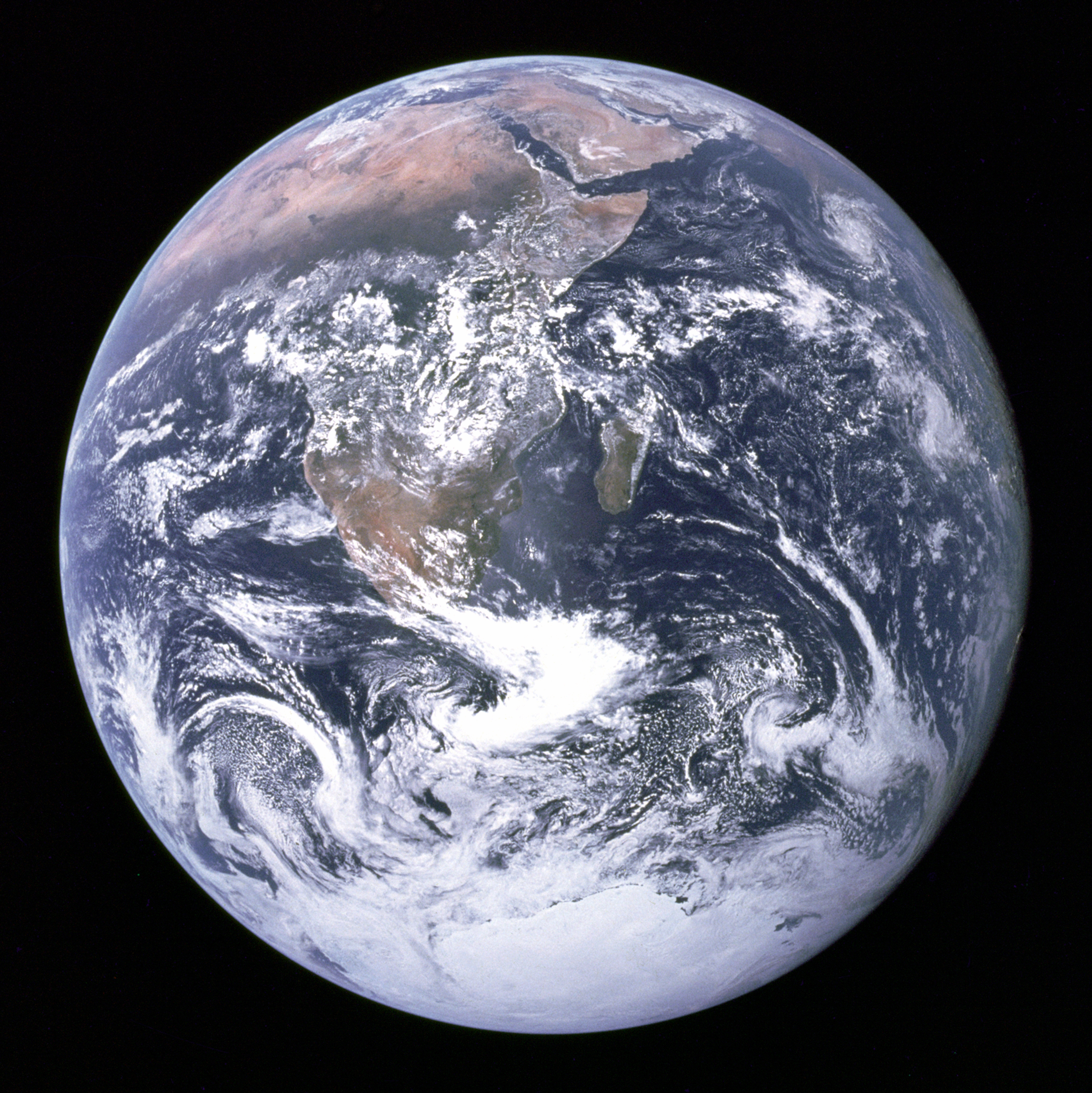
Earth (or the Earth) is the third planet from the Sun and the densest and fifth-largest of the eight planets in the Solar System. It is also the largest of the Solar System's four terrestrial planets. It is sometimes referred to as the World, the Blue Planet, or by its Latin name, Terra.
Home to millions of species including humans, Earth is currently the only astronomical body where life is known to exist. The planet formed 4.54 billion years ago, and life appeared on its surface within one billion years. Earth's biosphere has significantly altered the atmosphere and other abiotic conditions on the planet, enabling the proliferation of aerobic organisms as well as the formation of the ozone layer which, together with Earth's magnetic field, blocks harmful solar radiation, permitting life on land. The physical properties of the Earth, as well as its geological history and orbit, have allowed life to persist during this period. The planet is expected to continue supporting life for at least another 500 million years.
Earth's outer surface is divided into several rigid segments, or tectonic plates, that migrate across the surface over periods of many millions of years. About 71% of the surface is covered with salt water oceans, the remainder consisting of continents and islands which together have many lakes and other sources of water contributing to the hydrosphere. Liquid water, necessary for all known life, is not known to exist in equilibrium on any other planet's surface. Earth's poles are mostly covered with solid ice (Antarctic ice sheet) or sea ice (Arctic ice cap). The planet's interior remains active, with a thick layer of relatively solid mantle, a liquid outer core that generates a magnetic field, and a solid iron inner core.
Earth interacts with other objects in space, especially the Sun and the Moon. At present, Earth orbits the Sun once every 366.26 times it rotates about its own axis, which is equal to 365.26 solar days, or one sidereal year. The Earth's axis of rotation is tilted 23.4° away from the perpendicular of its orbital plane, producing seasonal variations on the planet's surface with a period of one tropical year (365.24 solar days). Earth's only known natural satellite, the Moon, which began orbiting it about 4.53 billion years ago, provides ocean tides, stabilizes the axial tilt and gradually slows the planet's rotation. Between approximately 3.8 billion and 4.1 billion years ago, numerous asteroid impacts during the Late Heavy Bombardment caused significant changes to the greater surface environment.
Both the mineral resources of the planet, as well as the products of the biosphere, contribute resources that are used to support a global human population. These inhabitants are grouped into about 200 independent sovereign states, which interact through diplomacy, travel, trade, and military action. Human cultures have developed many views of the planet, including personification as a deity, a belief in a flat Earth or in the Earth as the center of the universe, and a modern perspective of the world as an integrated environment that requires stewardship.

Uranus


File:Uranus2.jpg
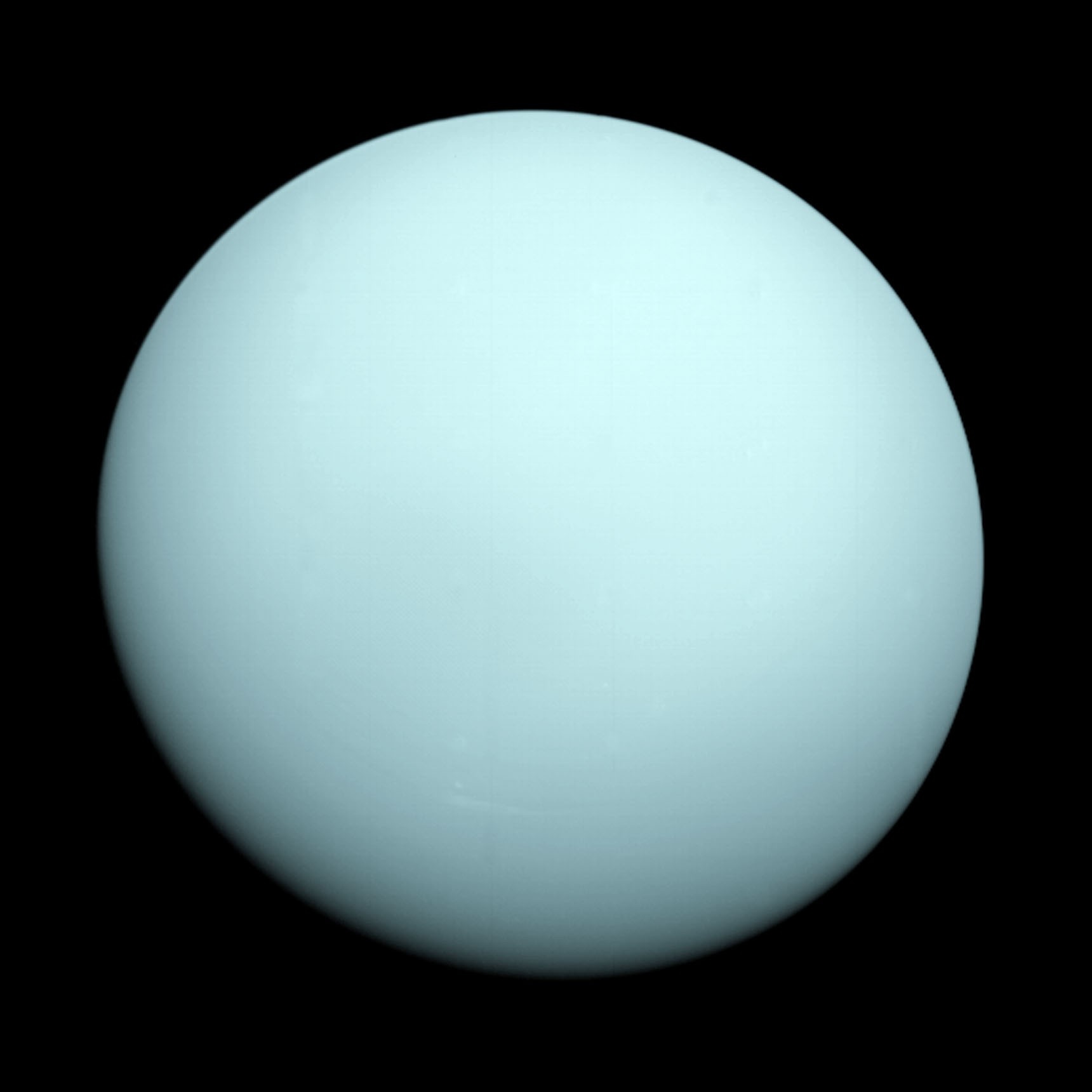
Uranus is the seventh planet from the Sun. It has the third-largest planetary radius and fourth-largest planetary mass in the Solar System. It is named after the ancient Greek deity of the sky Uranus (Ancient Greek: Οὐρανός), the father of Cronus (Saturn) and grandfather of Zeus (Jupiter). Though it is visible to the naked eye like the five classical planets, it was never recognized as a planet by ancient observers because of its dimness and slow orbit. Sir William Herschel announced its discovery on March 13, 1781, expanding the known boundaries of the Solar System for the first time in modern history. Uranus was also the first planet discovered with a telescope.
Uranus is similar in composition to Neptune, and both are of different chemical composition than the larger gas giants Jupiter and Saturn. As such, astronomers sometimes place them in a separate category, the "ice giants". Uranus's atmosphere, while similar to Jupiter and Saturn's in its primary composition of hydrogen and helium, contains more "ices" such as water, ammonia and methane, along with traces of hydrocarbons. It is the coldest planetary atmosphere in the Solar System, with a minimum temperature of 49 K (–224 °C). It has a complex, layered cloud structure, with water thought to make up the lowest clouds, and methane thought to make up the uppermost layer of clouds. In contrast the interior of Uranus is mainly composed of ices and rock.
Like the other giant planets, Uranus has a ring system, a magnetosphere, and numerous moons. The Uranian system has a unique configuration among the planets because its axis of rotation is tilted sideways, nearly into the plane of its revolution about the Sun. As such, its north and south poles lie where most other planets have their equators. Seen from Earth, Uranus's rings can sometimes appear to circle the planet like an archery target and its moons revolve around it like the hands of a clock, though in 2007 and 2008 the rings appeared edge-on. In 1986, images fromVoyager 2 showed Uranus as a virtually featureless planet in visible light without the cloud bands or storms associated with the other giants. However, terrestrial observers have seen signs of seasonal change and increased weather activity in recent years as Uranus approached its equinox. The wind speeds on Uranus can reach 250 meters per second (900 km/h, 560 mph)

Neptune


Neptune is the eighth and farthest planet from the Sun in our Solar System. Named for the Roman god of the sea, it is the fourth-largest planet by diameter and the third-largest by mass. Neptune is 17 times the mass of Earth and is slightly more massive than its near-twin Uranus, which is 15 times the mass of Earth but not as dense. On average, Neptune orbits the Sun at a distance of 30.1 AU, approximately 30 times the Earth-Sun distance. Its astronomical symbol is ♆, a stylized version of the god Neptune's trident.
Discovered on September 23, 1846, Neptune was the first planet found by mathematical prediction rather than by empirical observation. Unexpected changes in the orbit of Uranus led Alexis Bouvard to deduce that its orbit was subject to gravitational perturbation by an unknown planet. Neptune was subsequently observed by Johann Galle within a degree of the position predicted by Urbain Le Verrier, and its largest moon, Triton, was discovered shortly thereafter, though none of the planet's remaining 12 moons were located telescopically until the 20th century. Neptune has been visited by only one spacecraft, Voyager 2, which flew by the planet on August 25, 1989.
Neptune is similar in composition to Uranus, and both have compositions which differ from those of the larger gas giants Jupiter and Saturn. Neptune's atmosphere, while similar to Jupiter's and Saturn's in that it is composed primarily of hydrogen and helium, along with traces of hydrocarbons and possibly nitrogen, contains a higher proportion of "ices" such as water,ammonia and methane. Astronomers sometimes categorize Uranus and Neptune as "ice giants" in order to emphasize these distinctions. The interior of Neptune, like that of Uranus, is primarily composed of ices and rock. Traces of methane in the outermost regions in part account for the planet's blue appearance.
In contrast to the relatively featureless atmosphere of Uranus, Neptune's atmosphere is notable for its active and visible weather patterns. For example, at the time of the 1989 Voyager 2 flyby, the planet's southern hemisphere possessed a Great Dark Spot comparable to the Great Red Spot on Jupiter. These weather patterns are driven by the strongest sustained winds of any planet in the Solar System, with recorded wind speeds as high as 2,100 km/h. Because of its great distance from the Sun, Neptune's outer atmosphere is one of the coldest places in the Solar System, with temperatures at its cloud tops approaching −218 °C (55 K). Temperatures at the planet's centre, however, are approximately 5,400 K (5,000 °C). Neptune has a faint and fragmented ring system, which may have been detected during the 1960s but was only indisputably confirmed in 1989 by Voyager 2.

Saturn


File:Saturn during Equinox.jpg
Saturn is the sixth planet from the Sun and the second largest planet in the Solar System, afterJupiter. Saturn is named after the Roman god Saturn, equated to the Greek Cronus (the Titan father of Zeus), the Babylonian Ninurta and the Hindu Shani. Saturn's astronomical symbol () represents the Roman god's sickle.
Saturn, along with Jupiter, Uranus and Neptune, is classified as a gas giant. Together, these four planets are sometimes referred to as the Jovian, meaning "Jupiter-like", planets. Saturn has an average radius about 9 times larger than the Earth's. While only 1/8 the average density of Earth, due to its larger volume, Saturn's mass is just over 95 times greater than Earth's.
Because of Saturn's large mass and resulting gravitation, the conditions produced on Saturn are extreme if compared to Earth. The interior of Saturn is probably composed of a core of iron, nickel, silicon and oxygen compounds, surrounded by a deep layer of metallic hydrogen, an intermediate layer of liquid hydrogen and liquid helium and finally, an outer gaseous layer. Electrical current within the metallic-hydrogen layer is thought to give rise to Saturn's planetary magnetic field, which is slightly weaker than Earth's magnetic field and approximately one-twentieth the strength of the field around Jupiter. The outer atmosphere is generally bland in appearance, although long-lived features can appear. Wind speeds on Saturn can reach 1,800 km/h, significantly faster than those on Jupiter.
Saturn has nine rings, consisting mostly of ice particles with a smaller amount of rocky debris and dust. Sixty-two known moons orbit the planet; fifty-three are officially named. This is not counting hundreds of "moonlets" within the rings. Titan, Saturn's largest and the Solar System's second largest moon (after Jupiter's Ganymede), is larger than the planet Mercury and is the only moon in the Solar System to possess a significant atmosphere.

Venus


File:Venus-real.jpg
Venus is the second planet from the Sun, orbiting it every 224.7 Earth days. The planet is named after Venus, the Roman goddess of love and beauty. After the Moon, it is the brightest natural object in the night sky, reaching an apparent magnitude of −4.6, bright enough to cast shadows. Because Venus is an inferior planet from Earth, it never appears to venture far from the Sun: its elongation reaches a maximum of 47.8°. Venus reaches its maximum brightness shortly before sunrise or shortly after sunset, for which reason it has been known as the Morning Star or Evening Star.
Venus is classified as a terrestrial planet and it is sometimes called Earth's "sister planet" (see below) due to the similar size, gravity, and bulk composition. Venus is covered with an opaque layer of highly reflective clouds of sulfuric acid, preventing its surface from being seen from space in visible light. Venus has the densest atmosphere of all the terrestrial planets in our solar system, consisting mostly of carbon dioxide. Venus has no carbon cycle to lock carbon back into rocks and surface features, nor does it seem to have any organic life to absorb it in biomass. A younger Venus is believed to have possessed Earth-like oceans, but these evaporated as the temperature rose. Venus's surface is a dusty dry desertscape with many slab-like rocks, periodically refreshed by volcanism. The water has most likely dissociated, and, because of the lack of a planetary magnetic field, the hydrogen has been swept into interplanetary space by the solar wind. The atmospheric pressure at the planet's surface is 92 times that of the Earth.
The Venusian surface was a subject of speculation until some of its secrets were revealed by planetary science in the twentieth century. It was finally mapped in detail by Project Magellan in 1990–91. The ground shows evidence of extensive volcanism, and the sulfur in the atmosphere may indicate that there have been some recent eruptions. However, the absence of evidence of lava flow accompanying any of the visible caldera remains an enigma. The planet has few impact craters, demonstrating that the surface is relatively young, approximately 300–600 million years old. There is no evidence for plate tectonics, possibly because its crust is too strong to subduct without water to make it less viscous. Instead, Venus may lose its internal heat in periodic massive resurfacing events.

Sun


File:The Sun by the Atmospheric Imaging Assembly of NASA's Solar Dynamics Observatory - 20100819.jpg
The Sun is the star at the center of the Solar System. It is almost perfectly spherical and consists of hot plasma interwoven with magnetic fields. It has a diameter of about 1,392,000 km, about 109 times that of Earth, and its mass (about 2×1030 kilograms, 330,000 times that of Earth) accounts for about 99.86% of the total mass of the Solar System. Chemically, about three quarters of the Sun's mass consists of hydrogen, while the rest is mostly helium. Less than 2% consists of heavier elements, including oxygen, carbon, neon, iron, and others.
The Sun's stellar classification, based on spectral class, is G2V, and is informally designated as ayellow dwarf, because its visible radiation is most intense in the yellow-green portion of the spectrum and although its color is white, from the surface of the Earth it may appear yellow because of atmospheric scattering of blue light. In the spectral class label, G2 indicates its surface temperature of approximately 5778 K (5505 °C), and V indicates that the Sun, like most stars, is a main sequence star, and thus generates its energy by nuclear fusion of hydrogen nuclei into helium. In its core, the Sun fuses 620 million metric tons of hydrogen each second. Once regarded by astronomers as a small and relatively insignificant star, the Sun is now thought to be brighter than about 85% of the stars in the Milky Way galaxy, most of which are red dwarfs. The absolute magnitude of the Sun is +4.83; however, as the star closest to Earth, the Sun is the brightest object in the sky with an apparent magnitude of −26.74. The Sun's hot corona continuously expands in space creating the solar wind, a stream of charged particles that extends to the heliopause at roughly 100 astronomical units. The bubble in the interstellar medium formed by the solar wind, the heliosphere, is the largest continuous structure in the Solar System.
The Sun is currently traveling through the Local Interstellar Cloud in the Local Bubble zone, within the inner rim of the Orion Arm of the Milky Way galaxy. Of the 50 nearest stellar systems within 17 light-years from Earth (the closest being a red dwarf named Proxima Centauri at approximately 4.2 light years away), the Sun ranks 4th in mass. The Sun orbits the center of the Milky Way at a distance of approximately 24,00026,000 light years from the galactic center, completing one clockwise orbit, as viewed from the galactic north pole, in about 225–250 million years. Since our galaxy is moving with respect to the cosmic microwave background radiation (CMB) in the direction of constellation Hydra with a speed of 550 km/s, the sun's resultant velocity with respect to the CMB is about 370 km/s in the direction of Crater or Leo.
The mean distance of the Sun from the Earth is approximately 149.6 million kilometers (1 AU), though the distance varies as the Earth moves from perihelion in January to aphelion in July. At this average distance, light travels from the Sun to Earth in about 8 minutes and 19 seconds. The energy of this sunlight supports almost all life on Earth by photosynthesis, and drives Earth's climate and weather. The enormous effect of the Sun on the Earth has been recognized since prehistoric times, and the Sun has been regarded by some cultures as a deity. An accurate scientific understanding of the Sun developed slowly, and as recently as the 19th century prominent scientists had little knowledge of the Sun's physical composition and source of energy. This understanding is still developing; there are a number of present-day anomalies in the Sun's behavior that remain unexplained.

Moon

File:Full Moon Luc Viatour.jpg

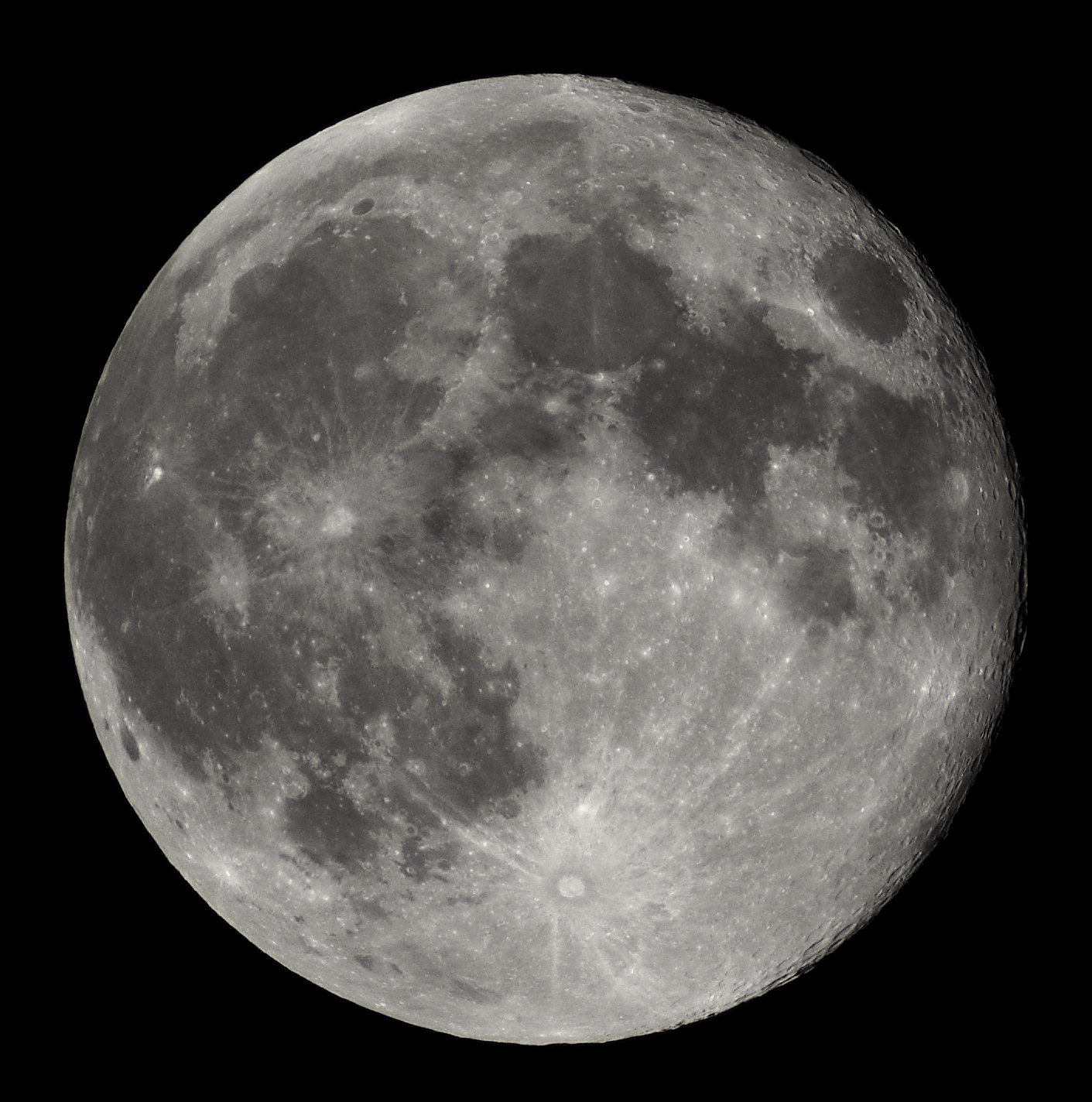
The Moon is Earth's only natural satellite and the fifth largest satellite in the Solar System. It is the largest natural satellite of a planet in the Solar System relative to the size of its primary (though Charon, which orbits the dwarf planet Pluto, is proportionally larger), a quarter the diameter of Earth and 181 its mass. The Moon is the second densest satellite after Io. It is in synchronous rotation with Earth, always showing the same face; the near side is marked with dark volcanic maria among the bright ancient crustal highlands and prominent impact craters. It is the brightest object in the sky after the Sun, although its surface is actually very dark, with a similar reflectance to coal. Its prominence in the sky and its regular cycle of phases have since ancient times made the Moon an important cultural influence on language,calendars, art and mythology. The Moon's gravitational influence produces the ocean tides and the minute lengthening of the day. The Moon's current orbital distance, about thirty times the diameter of the Earth, causes it to appear almost the same size in the sky as the Sun, allowing it to cover the Sun nearly precisely in total solar eclipses.
The Moon is the only celestial body on which humans have landed. While the Soviet Union's Luna programme was the first to reach the Moon with unmanned spacecraft in 1959, the United States' NASA Apollo program achieved the only manned missions to date, beginning with the first manned lunar orbiting mission by Apollo 8 in 1968, and six manned lunar landings between 1969 and 1972—the first being Apollo 11 in 1969. These missions returned over 380 kg of lunar rocks, which have been used to develop a detailed geological understanding of the Moon's origins (it is thought to have formed some 4.5 billion years ago in a giant impact event involving Earth), the formation of its internal structure, and its subsequent history.
After the Apollo 17 mission in 1972, the Moon has been visited only by unmanned spacecraft, notably by Soviet Lunokhod rovers. Since 2004, Japan, China, India, the United States, and the European Space Agency have each sent lunar orbiters. These spacecraft have contributed to confirming the discovery of lunar water ice in permanently shadowed craters at the poles and bound into the lunar regolith. Future manned missions to the Moon are planned but not yet underway; the Moon remains, under the Outer Space Treaty, free to all nations to explore for peaceful purposes.